
Expanding Land: The .io Game Where the Map Itself Is Alive

Most cell-eating .io games use a fixed arena, the map is the one constant while everything else changes around it. Expanding Land breaks that assumption directly: the playable area itself grows and shrinks in real time while players are still inside it, which changes the genre's core loop more than it might sound like at first.
What Is Expanding Land?
Expanding Land was created by developer Dimitrios Kyriakidis and first launched on March 8, 2026. It's a multiplayer .io-style game built around cell growth and territory, the same broad genre as games like Agar.io, but built entirely around a map that doesn't stay still.
The Core Idea: A Map That Expands and Contracts
Instead of a static arena, Expanding Land's playable space actively changes size while a match is in progress. During expansion, new territory gradually forms at the edges of the map, opening up fresh space to move into. During contraction, the available space shrinks in real time, forcing players into closer contact whether they're ready for it or not. Both transitions come with real visual feedback, the grid, borders, particles, food, and cells all react to the shift rather than just snapping to a new boundary.
That single mechanic changes the strategic layer of the genre: knowing when the map is about to expand or contract, and positioning accordingly, becomes as important as managing your own cell growth.
Built for Speed: Why the Game Is Written in C
Most browser-based .io games lean on higher-level web frameworks. Expanding Land is built entirely in the C programming language, with speed, responsiveness, and performance treated as top priorities rather than an afterthought. The goal, according to the game itself, is to be among the fastest cell games available, which matters more than usual here specifically because a dynamically resizing map adds real computational overhead most games in the genre never have to deal with.
The scale backs that up: Expanding Land describes itself as built to support up to 3,840 players in a single arena, with no bots padding out the player count.
Cell Deformation and Visual Polish
Beyond the map itself, Expanding Land adds detail most cell games skip entirely. Cells use jelly-style deformation, reacting and wobbling rather than staying as static circles, and the game has custom joining and death effects rather than generic spawn-and-pop animations. It's the kind of polish that doesn't change the core mechanic, but noticeably changes how the game feels to actually play.
Spectating, Stats, and Progression
Expanding Land includes a spectator mode and minimap system for watching matches in progress, along with player statistics, a league system, skins, and broader rewards and progression features layered on top of the core gameplay loop. That combination gives the game a longer-term structure beyond any single match, closer to what you'd expect from a persistent competitive game than a one-off browser distraction.
Where to Play
Expanding Land runs directly at expanding.land, or you can jump in through its listing on PlayKovo.
What's Next for Expanding Land
The stated long-term direction is to keep building on the core formula, more mechanics, stronger visual effects, and an increasingly dynamic world that keeps changing around players rather than settling into a fixed final state. For a game whose entire identity is built around a map that refuses to stay still, that's a fitting roadmap.
FAQ
What makes Expanding Land different from other .io cell games?
The playable map itself dynamically expands and contracts during a match, with real visual effects on the grid, borders, particles, food, and cells, rather than staying a fixed size like most games in the genre.
Who created Expanding Land?
Developer Dimitrios Kyriakidis, with the game first launching on March 8, 2026.
What programming language is Expanding Land built in?
C, chosen specifically for speed and performance, with the goal of being among the fastest cell games available.
How many players can be in one arena?
Up to 3,840 players per arena, with no bots padding out the count.
Does Expanding Land have anything beyond the core match gameplay?
Yes, it includes a spectator mode, minimap, player statistics, leagues, skins, and progression and reward features.
Is Expanding Land free to play?
Yes, you can play directly at expanding.land or through PlayKovo.
Final Thoughts
A lot of .io games differentiate through skins or minor mechanic tweaks. Expanding Land goes after something more fundamental, a map that's genuinely part of the gameplay rather than a static backdrop, built on a C-based engine specifically to keep that extra complexity fast. Worth a look if you've played enough static-map cell games to want the ground itself to start doing something.

Featured app
Expanding Land
Related Posts
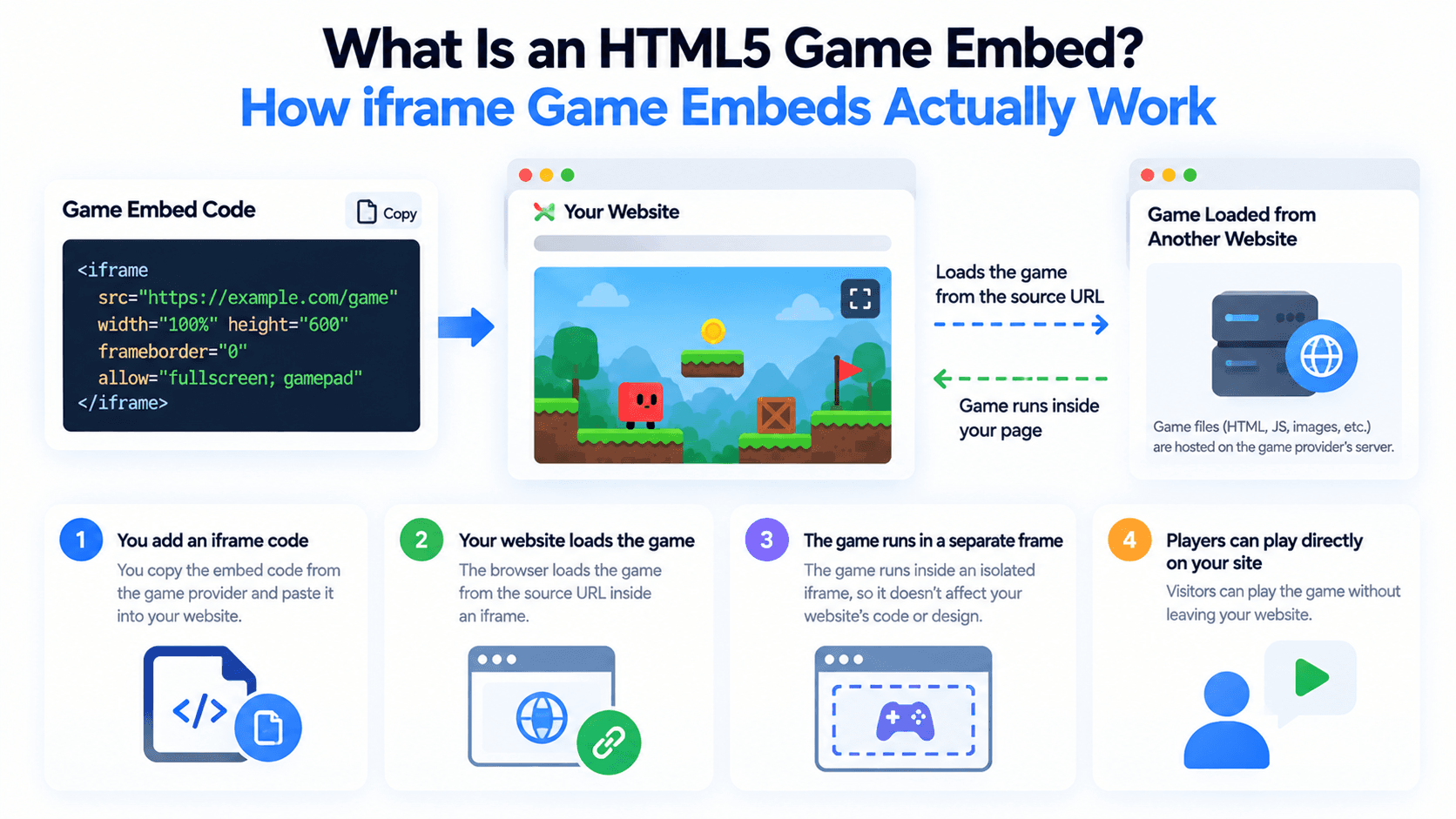
What Is an HTML5 Game Embed? How iframe Game Embeds Actually Work
Adding a free game to your site usually means embedding an iframe pointed at someone else's server. Here's what's actually happening under the hood, and what the src, allow, and sandbox attributes control.
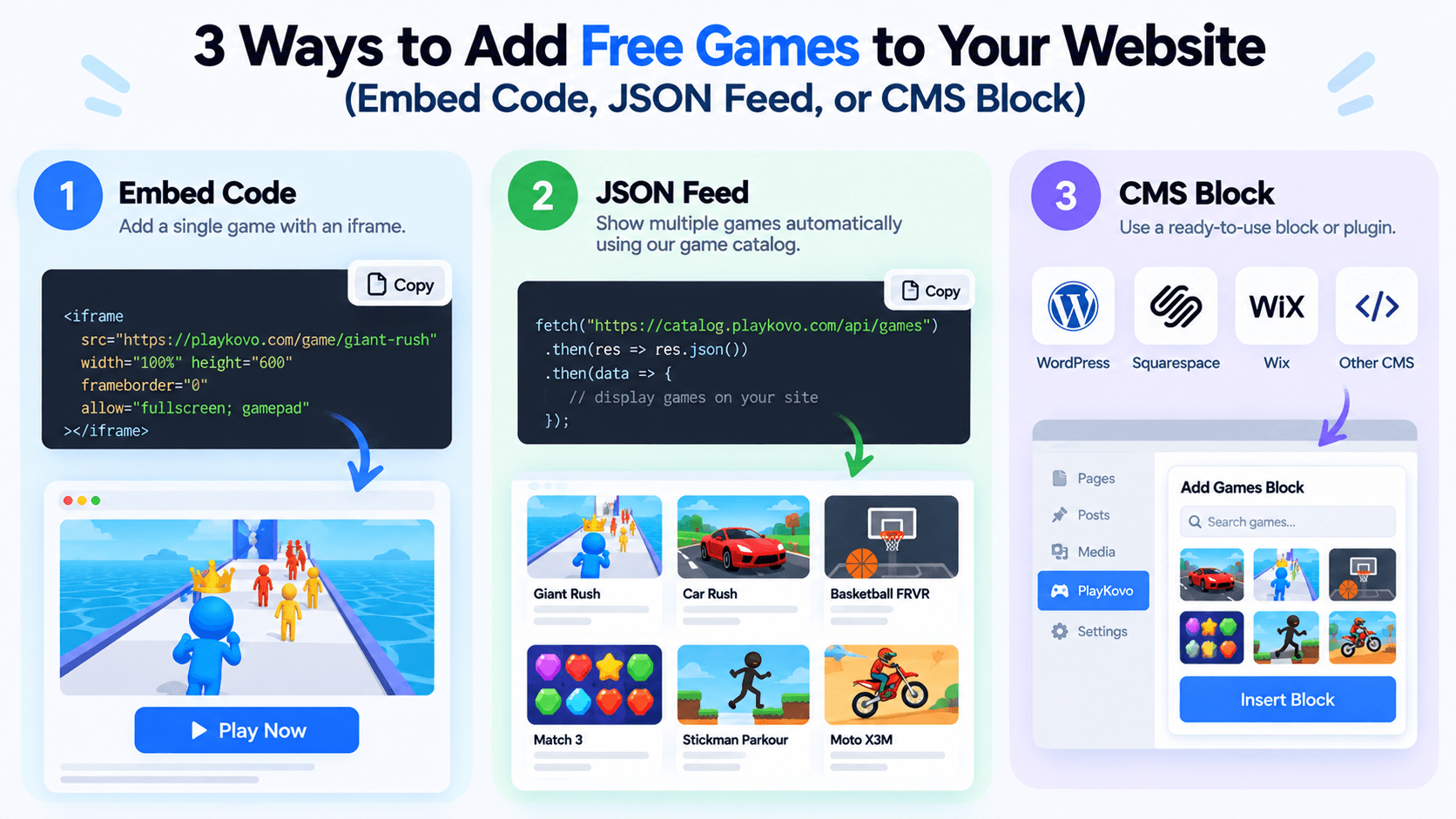
3 Ways to Add Free Games to Your Website (Embed Code, JSON Feed, or CMS Block)
There's more than one way to put free HTML5 games on your site, and the right one depends on how many games you want and how often that list should change. Here's a practical comparison of the three main options.

Before You Paste That Game Embed Code: A Checklist for Website Owners
An embed code is easy to copy and paste, which is exactly why it's easy to skip the questions worth asking first. Here's what to check before a free game goes live on your site.