Why Does Wordle Say "Not in Word List"?
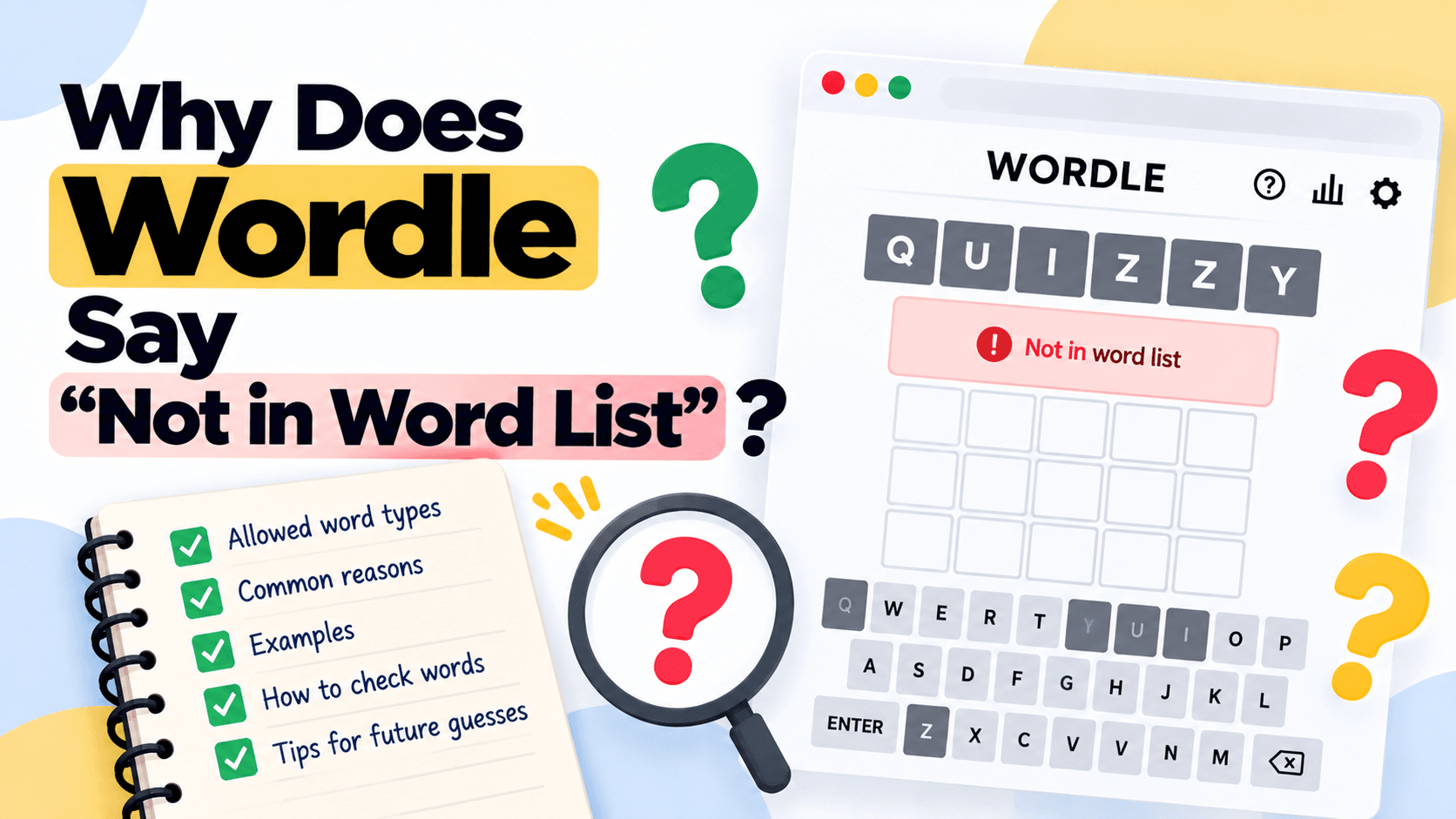
Wordle says "Not in word list" when what you typed is not in the list of guesses the game accepts. That list is not the dictionary, and it is not the list of possible answers either. We tested 55 five-letter entries in the live game on 16 October 2026 to show you which kinds of words get through, which do not, and what to do when a word you are sure of is refused.
What the message means
Wordle checks every guess against its list of accepted words. The first screen of the game says: "Each guess must be a valid 5-letter word." In practice "valid" means "in the game's list". If your guess is not there, the game shows "Not in word list" and keeps your letters on the row so you can change them. A rejected guess does not cost you one of your six tries.
Two other messages are easy to confuse with it. A guess with fewer than five letters shows "Not enough letters". And the row holds only five tiles, so letters typed after the fifth are ignored. That matters when you try a six-letter word: the game reads only the first five letters, and you may get a "Not in word list" for a word you never entered.
Three lists, not one
It helps to separate three ideas:
| List | What it contains | What it is for |
|---|---|---|
| A dictionary | Every real word, including rare, new and regional ones | Defining words |
| Wordle's accepted guesses | A long list of five-letter words the game allows | Checking what you type |
| Wordle's answers | A much shorter list from which a daily solution is chosen | Choosing the puzzle |
Reports at the time the New York Times took over the game said the answers were curated and the much larger list of valid guesses was not, and that words ending in "S" or "ES" as plurals were dropped from the answers while staying valid as guesses. Those are secondhand reports. We could not open NYT's own pages with our tools. What we can say first-hand is what the live game accepts today, below.
What we tested
We typed words from different categories into the live game. Whether a word was accepted is a fact about the game on that day. Lists can change, so do not treat it as permanent.
| Kind of word | Accepted | Rejected |
|---|---|---|
| Regular plurals | BOOKS, TREES, LAMPS, WALKS | None in our test |
| Past-tense and inflected verbs | LIKED, MOVED, ASKED | None |
| Everyday words that are also place names | PARIS, TEXAS, JAPAN | |
| First names and proper names | HENRY, ROBIN | ALICE, DAVID, STEVE |
| British spellings | FIBRE, METRE, LITRE | None |
| American spellings | FIBER, METER, LITER, COLOR | None |
| Modern and informal words | EMOJI, VIBES, MEMES, EMAIL, VLOGS, BLOGS, ZOOMS | None |
| Loanwords | AMIGO, PIZZA, SUSHI, TACOS, KARMA | None |
| Rare dictionary words | QUOTH, ZLOTY, AALII, CWTCH | None |
| Word families | EIGHT, FIGHT, LIGHT, MIGHT, NIGHT, RIGHT, SIGHT, TIGHT, BIGHT, WIGHT | None |
| Interjections | SHHHH, ARGHH, HMMMM | |
| Keyboard mashing and nonsense | ZZZZZ, QWERT, ASDFG, HAHAH |
Some lessons from that table:
- The list is generous. It took obscure words (AALII, CWTCH, BIGHT) and modern words (EMOJI, VLOGS).
- Both British and American spellings pass. Spelling variants of the same word were both accepted in our test.
- Names are the gap. ALICE, DAVID and STEVE failed, while HENRY and ROBIN passed. We believe the ones that passed are also ordinary words (a unit of inductance, a bird), but we have not seen the list and we do not claim a rule. A name is a gamble.
- Sounds and nonsense fail. "SHHHH" is a word you can say, and it was rejected.
- A word's presence in the guess list does not mean it can be an answer. We tested guesses only.
Why a word you are sure about may be refused
- It is not in the list. Dictionaries are larger than the guess list, and the game owner decides what is allowed.
- It is a proper name. Some are in, many are not.
- It has an unusual form. Compound words, hyphenated words and abbreviations are common refusals.
- You typed more than five letters. The sixth letter is ignored, so the game checks only the first five.
- A typing slip. An adjacent key can produce a plausible-looking nonsense word.
Five things to do when you see the message
- Check the spelling and the length. Count five tiles and read them aloud.
- Try the other spelling. British and American variants were both accepted in our test, but another form of the same word may differ.
- Try a related form. A plural or a past tense can be accepted when the base form is not available at five letters.
- Drop the idea of a name. Names are the most reliable way to waste thirty seconds. Use a common word instead.
- Keep playing. A rejected guess costs nothing, so there is no penalty for trying a word to see if it is accepted, except your time.
A trick that follows from the rules
Because rejected guesses cost nothing, you can check a doubtful word quickly: type it and press Enter. If it is refused, delete it and try another. If it is accepted, it costs one of your six tries, so only do it with a word you are happy to use. This is a general property of the game, and it is not a way to learn the answer.
What this does not tell you
- It does not tell you which words can be answers. The daily answer is chosen from a smaller list.
- It does not cover every word. We tested 55 entries, and a different set could behave differently.
- It does not describe other versions. Clones, apps and Wordle-style games each keep their own lists. See our Wordle alternatives guide for other games.
The takeaway
"Not in word list" means "the game does not accept this string as a guess", and the game's list is wide but not a dictionary. Names and sounds are the usual failures, and unusual words and spelling variants usually pass. When in doubt, use a common word, because a rejected guess is free.
Related Posts
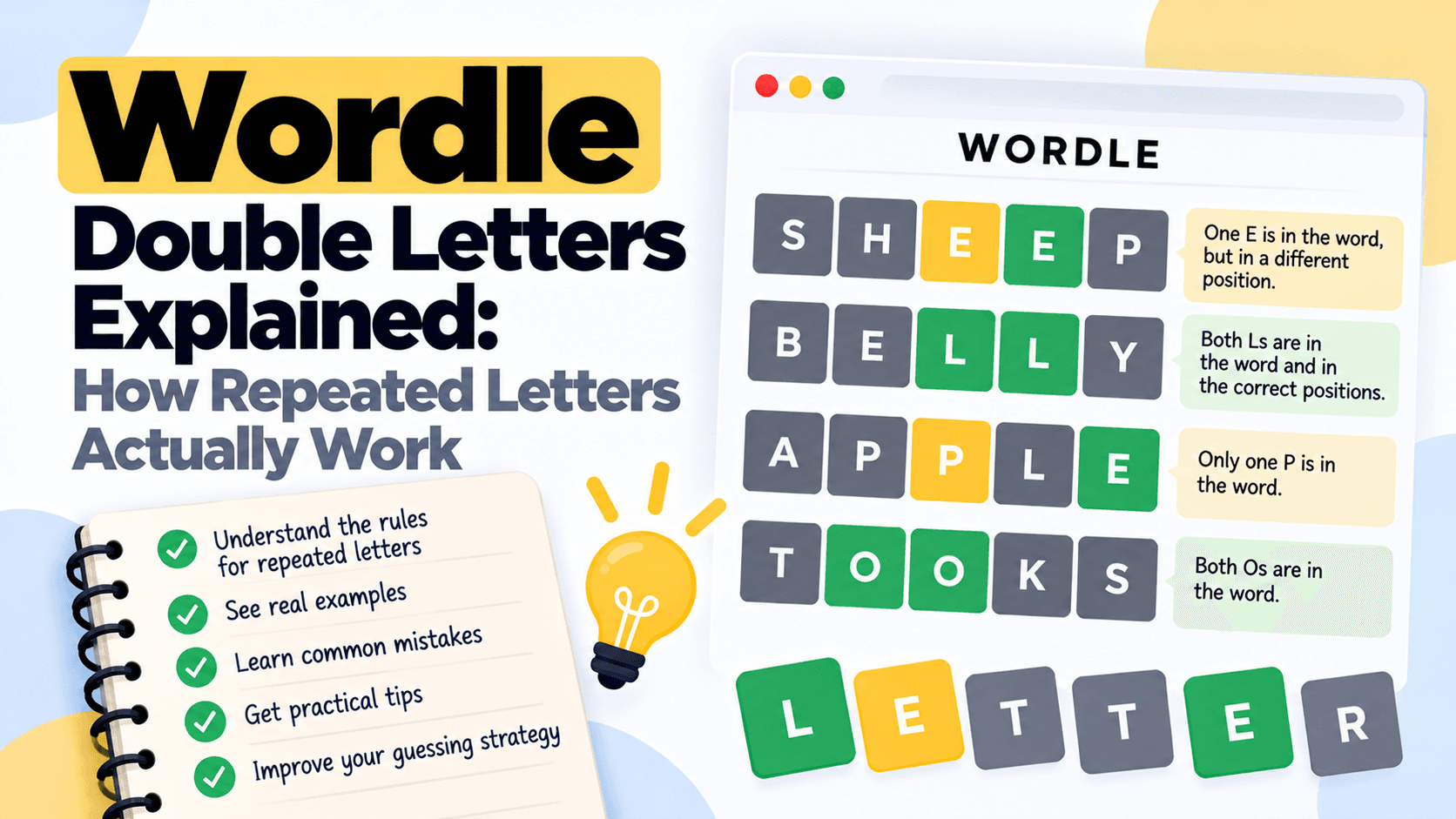
Wordle Double Letters Explained: How Repeated Letters Actually Work
When a letter appears twice in your guess, Wordle colors it by counting copies, not by asking "is it in the word?". Here is the exact rule, tested against the live game, with real boards, a color table and an interactive practice tool.
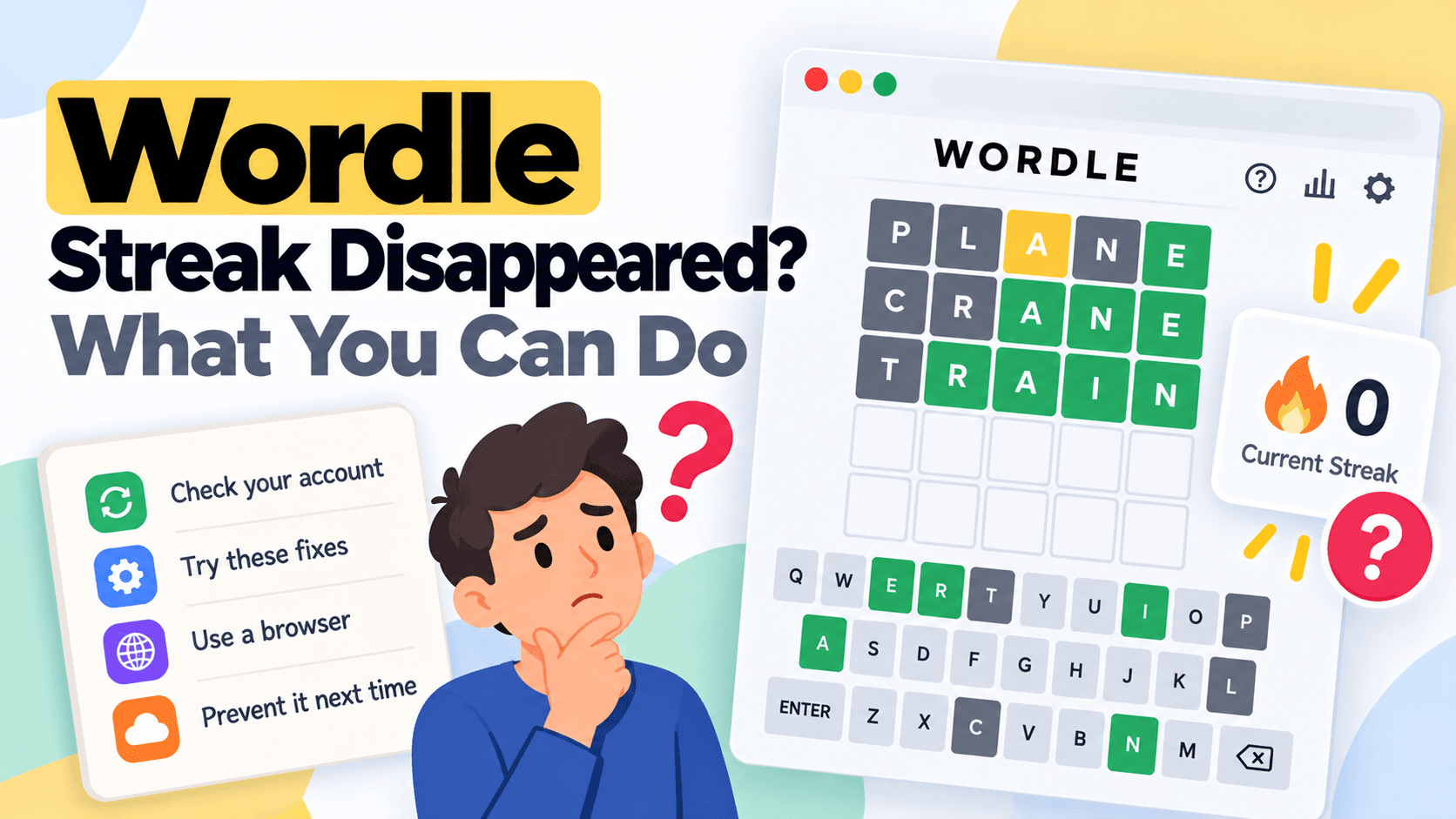
Wordle Streak Disappeared? What You Can Do
A Wordle streak is stored in your browser unless you are logged in to an NYT account. We tested what happens to a signed-out player's stats when the page reloads, when site data is cleared and in a fresh browser, and list fixes by symptom, with honest limits on what can be recovered.
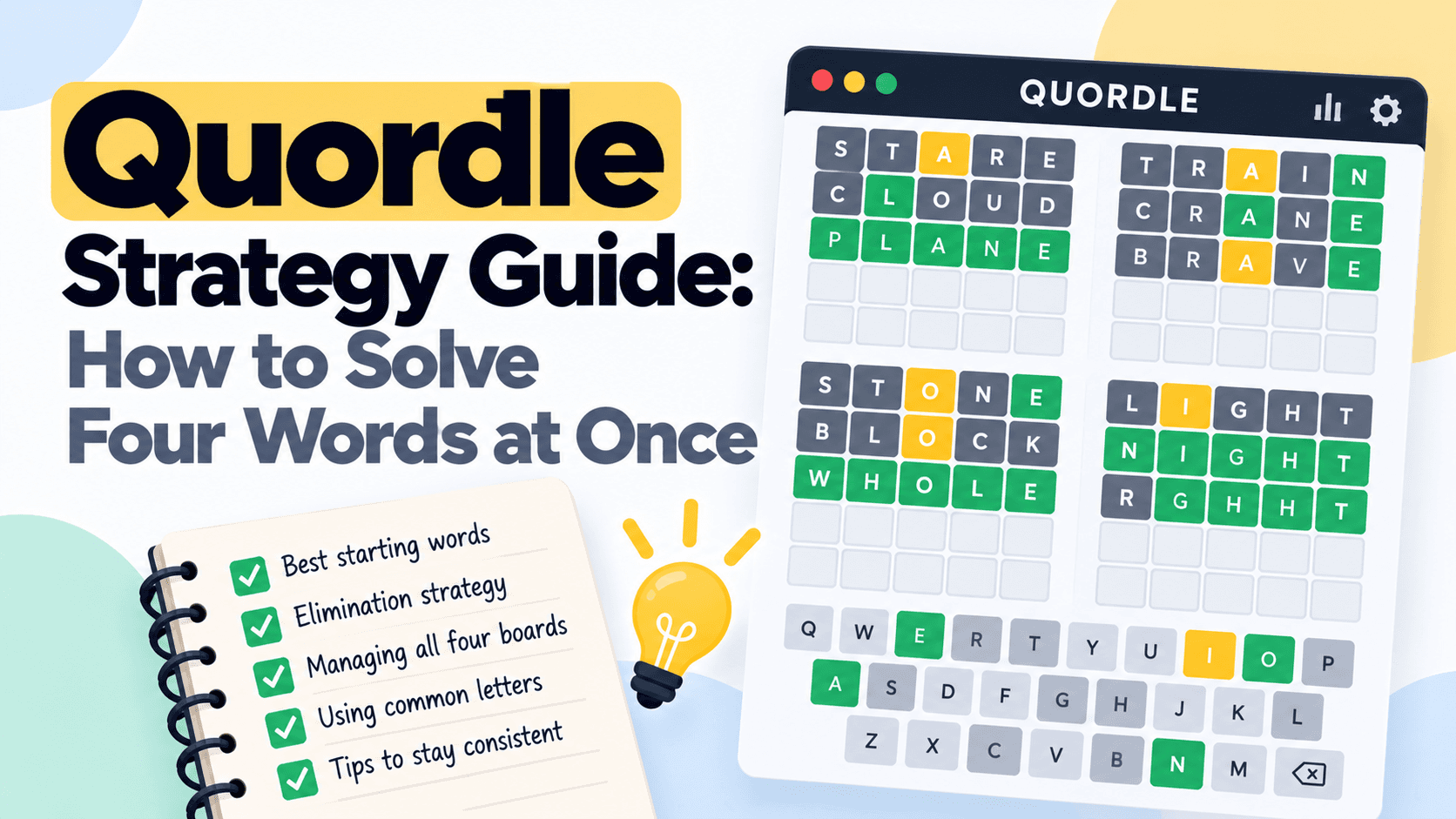
Quordle Strategy Guide: How to Solve Four Words at Once
Quordle gives you nine guesses for four hidden words and applies each guess to all four boards. We played the live game to confirm the mechanics, and this guide turns them into a practical plan: how to open, when to focus on one board and how to spend your last guesses.