Quordle Strategy Guide: How to Solve Four Words at Once
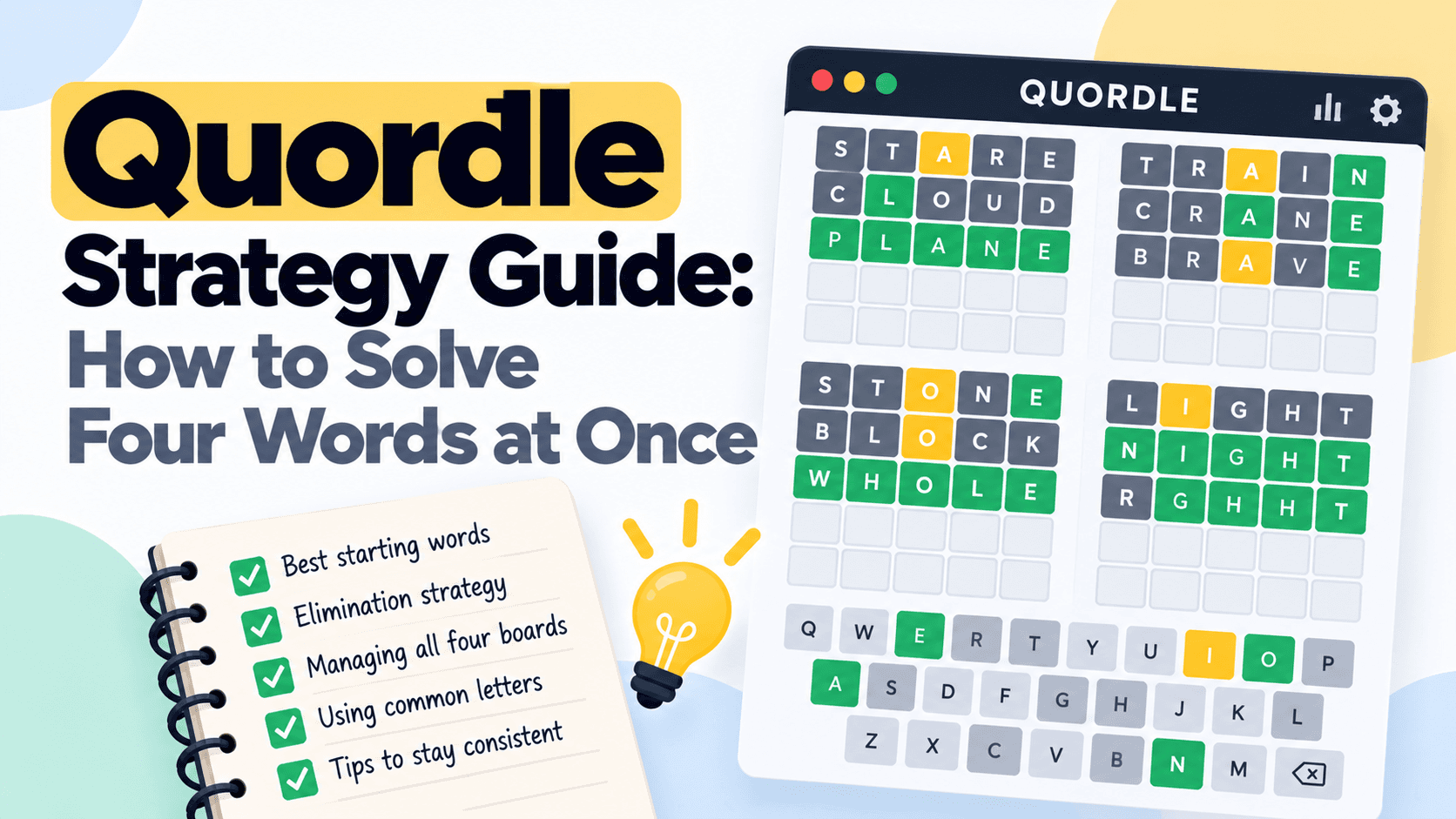
Quordle asks you to solve four five-letter words with nine guesses, and every guess you type is scored on all four boards at once. The winning idea is simple: use the early guesses to gather letters for all four boards, then spend the later guesses finishing the boards one at a time. This guide shows the mechanics we confirmed in the live game, then a plan built on them.
What we checked. Quordle is played at Merriam-Webster's games site. On 16 October 2026 we opened the live Classic mode, read its description and played two sessions. In the first we used all nine guesses and checked every row of feedback against a scoring program (all 36 rows matched). In the second we typed the four answers, which the first session had revealed, to watch how the game treats a solved board. The worked example below is a computed practice scenario, not a daily puzzle we solved.
The rules, as the live game shows them
The game's menu lists several modes. The description for the default one reads "Classic: 9 guesses to solve 4 words". The others on that page are Extreme (8 guesses, more unusual words), Chill (12 guesses, fewer unusual words), Sequence (solve one word at a time) and Rescue, plus a Weekly Challenge. This guide is about Classic.
What we saw in a game:
- Four boards, one keyboard. Each guess you type appears as a row on all four boards.
- Colors work as in Wordle. Green is the right letter in the right spot, yellow is in the word but elsewhere and gray is not available. A board keeps its own colors: a letter can be green on one board and gray on another.
- Nine rows per board. After nine guesses without solving, the game ended with "So close!" and showed the four answers.
- A solved board stops. When we typed the first answer, that board marked its row as correct and received no more rows. The other three boards kept adding rows with each guess. After the fourth answer the game said "Congrats!".
- The guess counter is shared. Solving a board early does not give you extra guesses on the others, but it does stop that board from using the nine.
How Quordle differs from Wordle
| Wordle | Quordle (Classic) | |
|---|---|---|
| Hidden words | 1 | 4 |
| Guesses | 6 | 9 |
| Feedback per guess | One row | Four rows, one per board |
| Guesses per word | 6 | About 2.25 on average across all four |
| Can you ignore a board? | Not applicable | Yes, but it still takes guesses to solve it |
The last two rows explain why Quordle feels harder. Nine guesses spread over four words leaves about two and a quarter guesses per word, while Wordle gives six to one word. But you receive four times the information from every guess, which is why the strategy changes.
A plan in four phases
Phase 1: Guesses 1 and 2 (gather)
Use two openers with different letters, for example a word with common vowels followed by a word with common consonants. The aim is to find letters on as many boards as possible. You do not need to solve anything yet.
Why it works: one guess gives you up to 20 tiles of information. Two distinct openers can touch 10 different letters.
Phase 2: Guesses 3 and 4 (steer)
Pick a guess that uses the letters you now know, in new positions, and adds new letters you have not tried. If a board already has two or three greens, treat it as a candidate for early solving.
Phase 3: Guesses 5 to 7 (focus)
Choose the board with the most information (the most greens) and try to solve it. Solving a board stops it taking more guesses and frees later guesses for the rest. This is usually the moment to switch from "gather" to "solve".
Phase 4: Guesses 8 and 9 (finish)
With two guesses left and more than one board unsolved, you cannot save every board. Decide which board can be solved with certainty and solve that first. If two boards are each one guess from certain, solve the one that gives you information for the other.
Five tactics that follow from the rules
- Do not repeat letters across openers. Repeating a letter in guesses 1 and 2 gives you little new information on the boards where it was gray.
- Write down gray letters per board. A gray on one board says nothing about another. This is the single most common source of mistakes for players moving from Wordle.
- Take a sure win early. Once a board is solved it stops using guesses, so every guess after that works for the remaining boards.
- Use a guess that fits two boards. The best mid-game guess is a word that could be the answer on one board and tests letters for another.
- Keep two guesses in reserve. If you reach guess 8 with two boards unsolved, you want both of your last guesses to be real candidates, not tests.
A worked scenario (computed, not a daily puzzle)
This is a practice example. We chose four answers and computed the colors with the scoring rule, which matched all 36 rows we checked against the live game.
The four answers are SPEED, TWEET, LLAMA and CRANE. Here is what a first guess of EERIE shows on each board:
What a player would learn from that single guess:
| Board | What EERIE reveals |
|---|---|
| 1 | Two Es (the third E tile is gray, so no more). R, I absent |
| 2 | Two Es (the third E tile is gray, so no more). R, I absent |
| 3 | No E, R or I |
| 4 | E at the end, and R somewhere else. The first two Es are gray, so only one E exists |
Note how the double-letter rule matters on board 4. The leading E tiles are gray even though E is in the word, because the green at the end used the only copy. Our guide to double letters in Wordle explains that rule in detail.
Common beginner mistakes
- Treating the four boards as one. A gray on one board is not a gray on the others.
- Chasing one board for too long. If one board needs three more guesses, the other three may go unsolved.
- Spending guesses on words that cannot be answers when you have many left unused, and then running short. Probes are cheap early and expensive late.
- Forgetting double letters. Gray repeats mislead more often in Quordle because there are four boards to track.
Which should you play?
If you want a quiet five minutes, Wordle is enough. If you like keeping several boards in your head, Quordle rewards tracking and planning. For more on word-game choices, see Wordle versus Quordle versus Lumira.
The takeaway
Quordle gives you nine guesses, four boards and shared feedback. Gather letters early, pick your first board to solve by the middle of the game and keep two real candidates for the end. Track each board's gray letters separately and remember that a gray repeat can mean "no copy left".
Related Posts
Wordle Streak Disappeared? What You Can Do
A Wordle streak is stored in your browser unless you are logged in to an NYT account. We tested what happens to a signed-out player's stats when the page reloads, when site data is cleared and in a fresh browser, and list fixes by symptom, with honest limits on what can be recovered.
How to Practice Wordle Without Looking Up Answers
Improving at Wordle does not require checking solutions. This guide gives a seven-day, spoiler-free practice plan, three letter-elimination drills with worked boards, a tracking table and a weekly checklist.
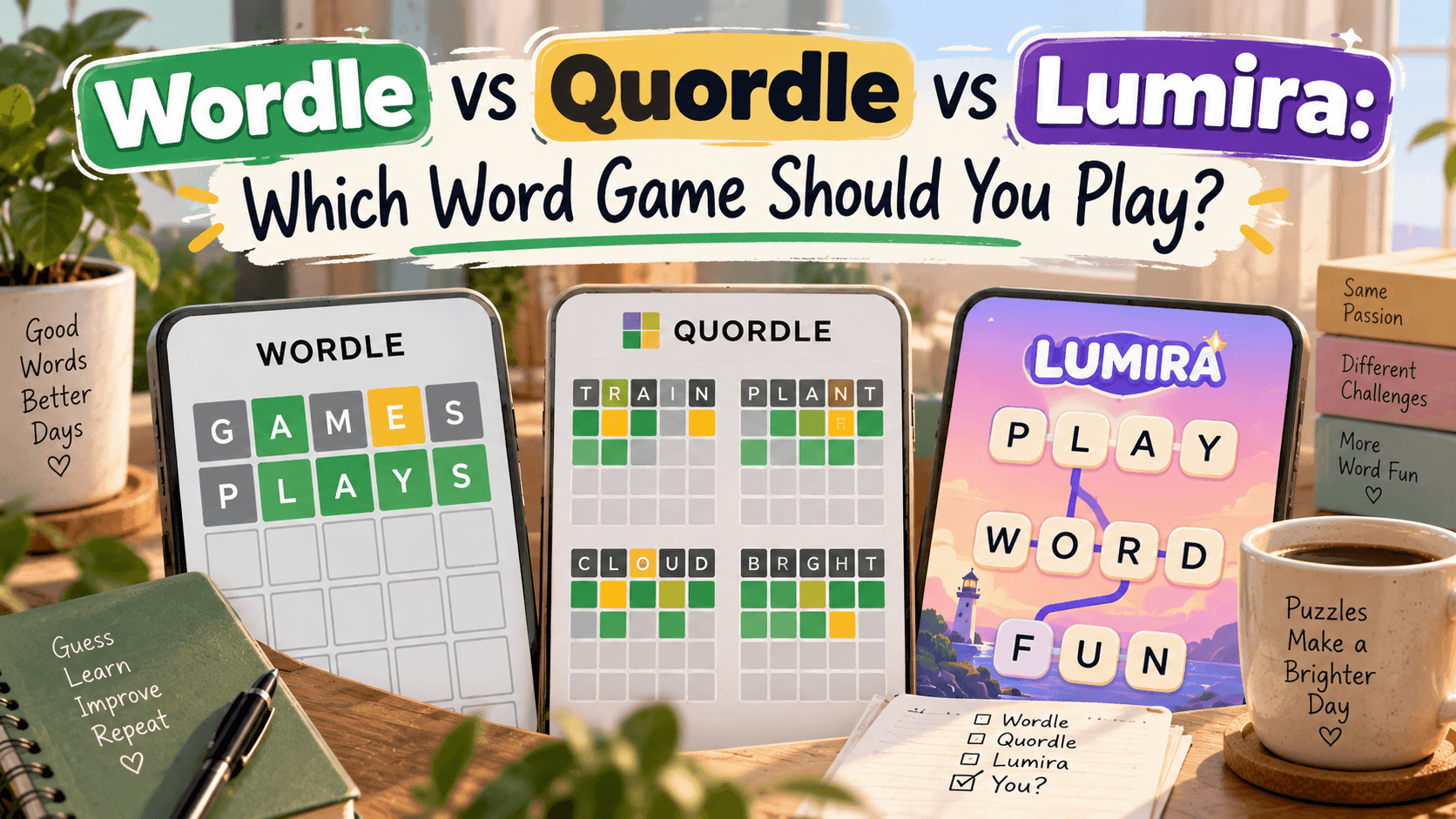
Wordle vs Quordle vs Lumira: Which Word Game Should You Play?
All three are guess-the-word puzzle games, but they solve very different problems. Here's a direct, honest comparison of Wordle, Quordle, and Lumira to help you figure out which one actually fits how you want to play.