
Toy Box Challenge: The Physics Stacking Puzzle Where the Weird Towers Are the Point
Most stacking puzzle games give you a fixed set of pieces and one obvious way to use them. Toy Box Challenge takes a different approach: the rule is simple enough to understand in ten seconds, but the actual solutions players come up with end up looking nothing alike.
What Is Toy Box Challenge?
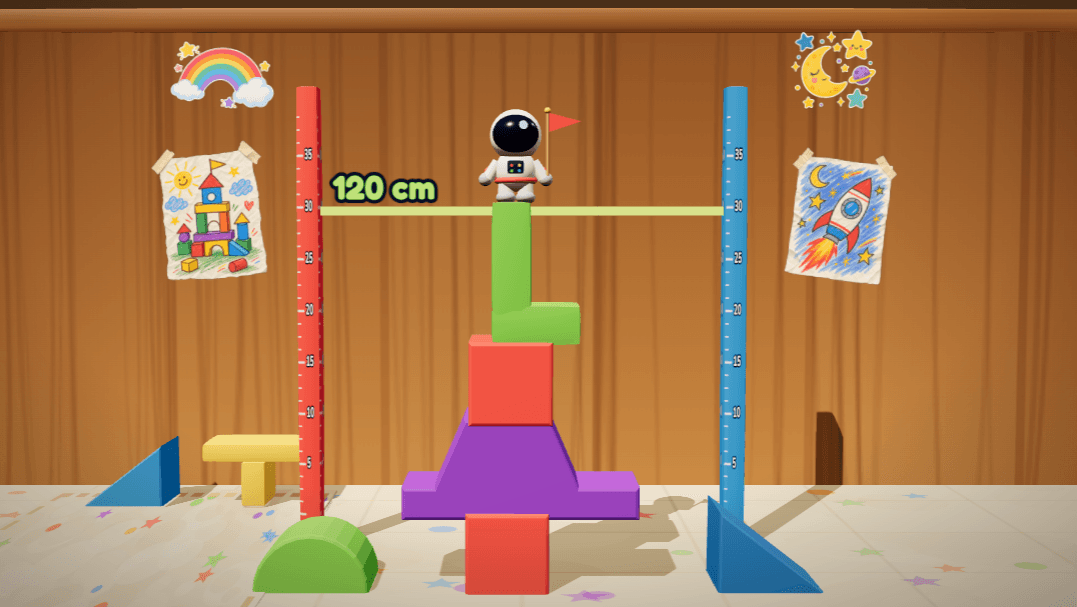
Toy Box Challenge is a physics-based stacking puzzle game. Each level gives you a set of toy-shaped blocks, and the goal is to build a structure with them and place Astro, a small astronaut character, above a target height marked on the level. The catch is physics: your structure has to actually stay stable long enough for the level to count as complete, gravity and balance are real constraints, not just a visual flourish.
How It Works
The core loop is straightforward: pick from your available blocks, stack them however you think will hold, and set Astro on top once you've cleared the target line. What makes it a genuine puzzle rather than a toy is that there's rarely one "correct" tower, a wide base and careful balance can get you there just as well as a tall, precarious stack, provided it actually holds up under its own weight.
Built With an AI-Assisted Development Workflow
Toy Box Challenge was built as part of an explicit experiment in creating polished browser games quickly using an AI-assisted development process. Developer Omer Hadar handled the game and product design and iteration directly, while AI tools were used heavily throughout both development and testing. It's a practical example of how fast a small, focused browser game can come together with that kind of workflow behind it.
From 8 Levels to 16: How Player Data Reshaped the Game
The first public version of Toy Box Challenge shipped with 8 levels. Feedback and actual gameplay data showed a pattern worth fixing: players could often lean on the same stacking strategy across multiple levels instead of needing to think differently each time. In response, the game was rebuilt around more varied inventories and structural puzzles, and now ships with 16 levels and a noticeably stronger difficulty curve than the original release. It's a good example of a small game actually being redesigned based on what players did with it, not just expanded with more of the same.
The Trophy Shot
One of the more interesting things that came out of testing wasn't a difficulty problem, it was a pleasant surprise: finished towers looked genuinely different from player to player, even on the same level. That observation directly led to the Trophy Shot feature, which captures a snapshot of your structure at the end of a level, turning your specific, often slightly ridiculous solution into something worth actually looking back at.
Who Made It
Toy Box Challenge was developed by Omer Hadar, with the underlying goal of keeping the physics mechanic itself immediately understandable while leaving real room for players to find their own creative way to solve each level.
How to Play
Toy Box Challenge is available to play free through PlayKovo, no download or install required.
FAQ
What is the goal in Toy Box Challenge?
Stack the available toy-shaped blocks into a stable structure and place Astro above the level's target height, the structure has to hold together for the level to count as complete.
How many levels does Toy Box Challenge have?
16 levels, expanded from the original 8-level release after feedback showed players needed more varied puzzles to avoid relying on a single repeated strategy.
What is the Trophy Shot feature?
A snapshot captured of your finished structure at the end of a level, added specifically because finished towers turned out to look strikingly different from player to player.
Who developed Toy Box Challenge?
Omer Hadar, built as part of an experiment in using an AI-assisted workflow to develop a polished browser game quickly.
Is Toy Box Challenge free to play?
Yes, it's free to play through PlayKovo, no download required.
Final Thoughts
Toy Box Challenge's whole design bet is that a simple, honest physics mechanic gives players more room to be creative than a rigid, scripted puzzle would, and the fact that testers kept producing genuinely different-looking towers is a pretty direct confirmation that bet worked. Worth a look if you want a puzzle game where the fun is less about finding the one right answer and more about seeing what your own answer ends up looking like.
Featured app
Toy Box Challenge
Related Posts
From Game Jam to Published Game: A Realistic Timeline for Solo Devs
A weekend game jam prototype and a genuinely published game are separated by more work than most solo developers expect going in. Here's a realistic breakdown of what that gap actually looks like.

Expanding Land: The .io Game Where the Map Itself Is Alive
Expanding Land takes the familiar cell-eating .io formula and adds something most games in the genre never touch: a playable area that actually expands and contracts while you're inside it. Built entirely in C for speed, it's aiming to be one of the fastest games in its genre.
Anagram Solvers: How They Work and When Using One Is Fair
An anagram solver can instantly unscramble letters into real words, which raises an obvious question for word-puzzle players: is using one cheating, or just a different way to play?