Which HTML5 Games Fit a Blog, News Website, or Community Portal?
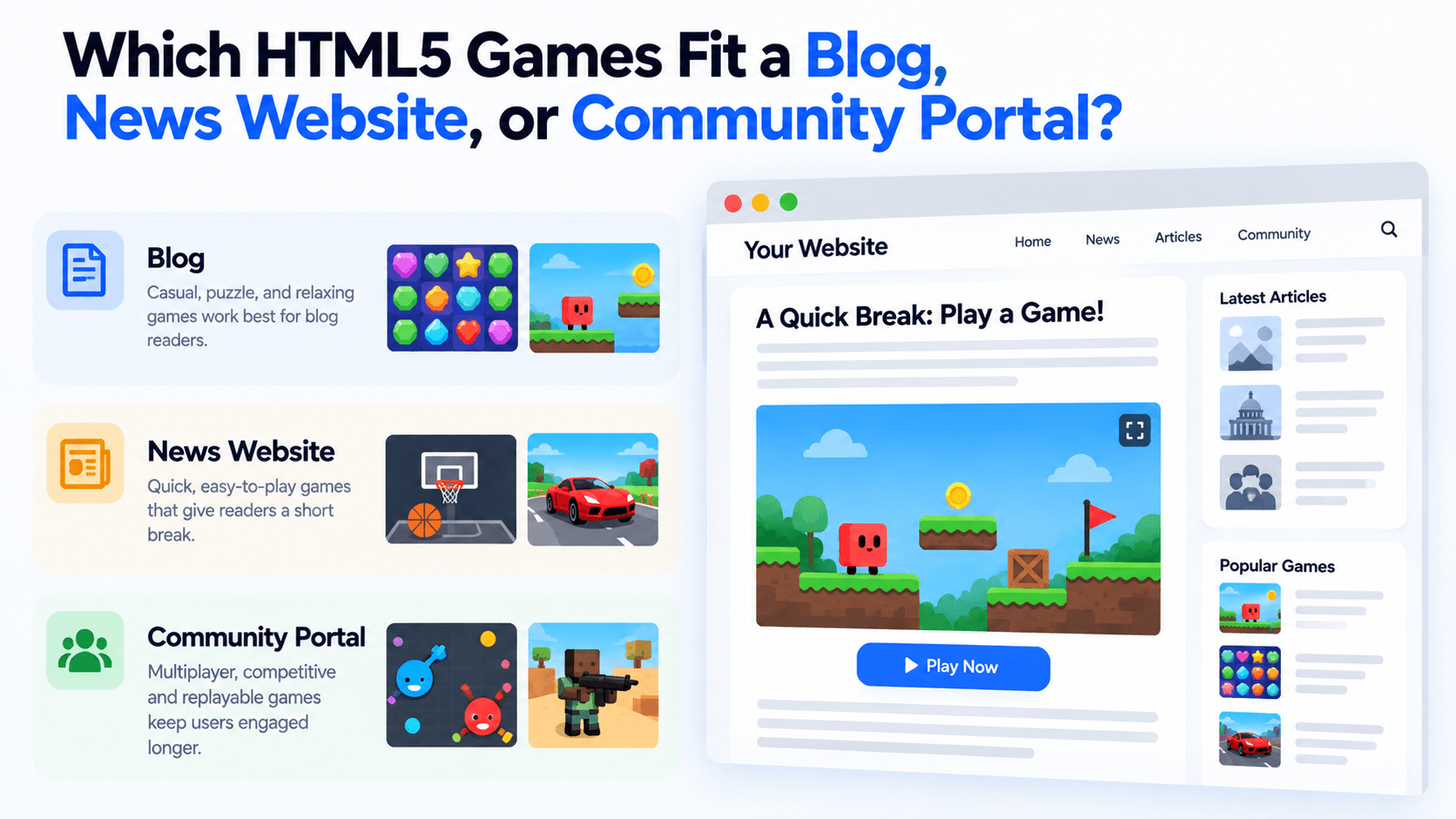
A game that works on one site can feel out of place on another. A fast reflex game on a news site can read as a distraction in the middle of an important story. A cosy puzzle on a technology blog can feel like a charming break. Fit is about three things: the mood of your content, the minutes your visitors have, and where on the site the game sits.
This guide goes through the main kinds of content site and suggests what to look for. Game details come from the PlayKovo embed feed read on 13 October 2026. The suggestions are editorial judgments, not tested results.
The principle: the game follows the reader, not the other way round
A reader on a news site is in "catch up" mode. A reader on a hobby blog is in "explore" mode. A reader in a community is in "hang out" mode. A game should extend that mode, not interrupt it.
Ask three questions for any placement:
- Does the visitor have time? (A two-minute break, or twenty?)
- Would the game feel respectful of the subject? (A shooter beside a story about a tragedy would not.)
- Does it help the visitor come back? (Variety and progress do; a single dead-end game does not.)
Site by site
News sites
What readers want: quick, low-commitment breaks after reading.
What fits: short rounds, one input, no sound dependency, no violent theme.
- Cream 2048: swipe or arrow keys, declared for all devices.
- Orbit Keeper: one tap, instantly understood.
- Minesweeper Kovo: classic logic with three difficulty levels.
Where it helps: a "Take a break" block at the end of an evergreen piece or on a dedicated games page.
Where it hurts: breaking news, serious reports and live blogs. Never place a frame beside sensitive stories.
Technology blogs
What readers want: curiosity, craft and a bit of nerdiness.
What fits: games with an interesting technical story, often played on a laptop.
- Q1K3: a first-person shooter squeezed into 13 kilobytes, with two Quake-inspired levels. Desktop only, and a shooter, so judge the tone for your readers.
- 13 Steps to Escape: a pixel-art puzzle where you only have 13 steps before you respawn. Desktop only.
- HexGL: a futuristic hover-ship racer, declared for all devices.
- Toy Box Challenge: a physics stacking game. Desktop only.
Where it helps: a "behind the build" article about browser games, or a games corner of the site.
Where it hurts: product reviews and documentation pages where readers are working.
Sports sites
What readers want: competition, rivalry, a sense of play.
The data here is thin. The embed feed's sports shelf contains only a couple of titles. Motorcar Volleyball is a two-player arcade sports game that shares one keyboard (desktop only), and Tideline is tagged as sports but is a relaxed fishing game. Neither is a match-day game.
If your readers expect football or basketball, the honest recommendation is to use the games sparingly: a "between matches" page with a couple of arcade picks and nothing on live match pages.
Education and learning sites
What readers want: mental exercise, clarity, a sense of progress.
What fits: logic and word games with clear rules.
- Lumira: Word Puzzle Game: spell words to fill a crossword grid, with 750 levels.
- Water Sort Puzzle: planning ahead.
- Minesweeper Kovo: reasoning from clues.
- 13 Steps to Escape: planning a route in a limited number of steps.
We are not claiming these teach any subject. They are break-time games that suit a thoughtful audience. If you serve children, check the content of each game and the ads that may appear inside it before you publish. The Partner Terms say you cannot block those ads.
Lifestyle and general content sites
What readers want: calm, pleasant, low stakes.
- Cozy Bakehouse: a bakery merge game, portrait.
- Tideline: relaxed 3D fishing.
- Sky Isles: explore floating pastel islands and ring wind chimes in order.
- Hexa Stack 3D: a relaxing sorting puzzle.
Where it helps: recipe and home pages, if the frame sits clear of the recipe card or the how-to steps.
Where it hurts: any page where readers follow instructions step by step. A game beside a cooking guide competes for attention at the worst moment.
Two games with the calm tone that suits a lifestyle site:
Try it live · PlayKovo catalog
A relaxing 3D fishing game. Cast your line, fight the fish, sell your catch and upgrade your gear to unlock new waters.
Explore a dreamlike world of floating pastel islands, ring the wind chimes in order, and glide between the clouds.
Community portals and forums
What members want: something to talk about and compete over.
- Stack Tower: build the tallest tower, a result members can compare.
- Orbit Keeper: survive as long as you can.
- Tower Building: stack blocks and chain perfect drops.
- Motorcar Volleyball: two players, one keyboard, good for a member challenge.
Where it helps: a weekly challenge thread that links to a game page, rather than a frame inside every thread.
Where it hurts: embedding a game inside the discussion thread itself. It slows the page and hides the conversation.
Where games belong on any site
| Page type | Game placement | Why |
|---|---|---|
| Dedicated games hub | Yes | The visitor came to play |
| End of an evergreen article | A small "take a break" block | The reader has finished |
| Homepage | Link only, no frame | Frames slow the page and compete with headlines |
| Breaking news or live blog | No | Distracting and often inappropriate |
| Tutorials and documentation | No | Readers are working |
| Forum threads | Link to a game page | Keeps threads fast |
| Newsletters | Link only | Email cannot run frames |
A few rules for every site
- Link, do not embed, wherever speed matters. One game per page is a good rule. The default code lazy-loads the frame.
- Mark desktop-only games. A visitor on a phone should be told before they tap.
- Keep ads in mind. Games may show PlayKovo promotions or third-party ads that you cannot block or hide. Judge the placement as a whole, not just your own banner.
- Credit the source. Say the games come from PlayKovo, and do not present them as your own.
Choose, then confirm
Pick two or three candidates for your type of site, play each yourself on a phone and a laptop, and read the terms for the provider you use. If you want a structured way to score them, our guide on choosing games for your audience has a worked scorecard.
Related Posts

How to Choose the Right HTML5 Games for Your Website's Audience
A five-criteria scoring system for picking embeddable HTML5 games that fit a news site, blog, game portal or community, with a worked example using real PlayKovo catalog games.
A Curated 20-Game Starter Library for a New Arcade Website
Twenty embeddable HTML5 games from the PlayKovo catalog, balanced across puzzle, casual, arcade, action and sports, with controls, device support and publishing notes for each.
How to Compare Free HTML5 Game Catalog Providers Before Embedding
An independent checklist and scoring grid for comparing HTML5 game catalog providers, applied to PlayKovo, Playgama and GameMonetize using only what each publishes.